Patrick Kelly, OJAC Director and Curator, interview with artist Mckee Frazior (August 2026)
PK: You categorize yourself as a “hypermedia” artist. For me and the readers, can you clarify what that means in the simplest of terms?
MF: Hypermedia is a nod to the interconnected nature of my work. I rarely have pieces that exist as singular objects; they tend to be in networks and somewhat linked to each other or the internet. They also require some activation or interaction from the audience. I like work that activates you as a participant or a node. So, I've never really felt I've fit into new media, or multimedia, or transmedia. I make things that are systems that you function inside, or they function around you. Your interaction or experience is integral to the functioning of the piece. When I say hypermedia, I mean something more than just using multiple mediums, telling a story across multiple mediums, or just trying to use new technology as a medium. I tend to lean more toward using established technologies in ways that are fun and engaging, but at the same time a little off-putting and absurd. Technology really lends itself to the absurd. So hyper is a nod to interconnectedness, speed, and the ability to navigate or play with the art, and it’s stolen from the H in HTML (Hypertext Markup Language). The internet is even defined as hypermedia in that it presents all kinds of media together, whether it be text, video, games, audio, or just Wikipedia rabbit holes.
PK: If I recall, you have a background in computer programming…was it gaming related? What occurred to make the switch and apply your skills to make works that fall into this relatively new category of art?
MF: Yeah, I’ve always trended towards computers and technical things. In undergrad I flitted between Video Art and Printmaking. So, the two most techie disciplines that required process to get anything out of anything. In undergrad, I ended up starting to play with Flash and something called Director, and I made a few interactive videos that were basically choose-your-own-adventure videos. I was interested in presenting audiences with something non-linear and discovering how linear narratives emerged from that. At the same time, I was making prints that needed to be cut up or reassembled, and that was the start of trying to focus on interactivity and art. I ended up going to video game design school to learn more about interactivity and, hopefully, programming. I didn’t quite learn to program until my early 30s? Eventually I got decent enough to do web programming and development. It was a long road, and eventually it just became the best way I could figure out to make things interactive and incorporate randomness and chance while activating the viewer and inviting them to play.
The switch was gradual, but computers had always been part of my creative life from a very young age. I was lucky enough to have a very crude animation program on my computer that I played with a lot in my free time. I also had a weird precursor to the game Myst called Manhole, I think? It was a kids' point-and-click adventure. It was loosely themed around Alice in Wonderland. As you explored, you assembled your own narrative and logic for whatever was happening. I think that experience, along with a few other educational video games, made me really interested in interactivity and puzzles, and how they fit well with computers and programming. In college I used programs like Photoshop and the computer lab to create imagery for prints, then I’d disassemble and reassemble it in the printmaking process. At that time, I was really trying to make work that people could reassemble and mutate on their own.
I think my fascination with programming and technology really circles back around to figuring out how to use the things that are now somewhat commonplace but used to be rare, exotic, and inaccessible. I believe that’s why a lot of my work ends up with a web component. It’s this residue that lives past the installation or objectness. I’ve always kind of struggled with the materiality and objectness of art because the idea is always what captivates and sticks with me.
PK: As your work develops, is the viewer participation or interaction becoming more important? I think a lot of digital work strives for the “ooh and ahh” reaction from viewers.
MF: The viewer interaction has always been fairly important. I’ve always used strategies to slow down a viewer's consumption of a work. One thing that bugged me about a lot of video game development was that the focus at the time was on juicy, visceral experiences that tended toward total sensory overwhelm, quick feedback, and quick responses. I mean, I’m horrible at typical video games. So, if there is any twitch factor in the game, I normally don't last long. I've always preferred video games that can be played with another person at the same time. I was lucky to grow up in that era of playing games in the same room with your friends, not disembodied strangers.
So yeah, a lot of digital work goes after that ooh and ahh, that visceral feeling, which is definitely a part of a lot of interactive and generative work you see out there. That kind of work is certainly fun in the moment, but it rarely lasts outside the experience. When I think about interaction, I try to focus more on a “huh” moment. I want people to interact with the piece and have it slightly confuse or interrupt them just enough that they lean in, play with it, and explore its limits. Through that moment of confusion and play, the piece becomes something more like a song or piece of music that we are improvising together, or at least I hope so.
I feel like a lot of interactive generative work maybe uses the audience as material or input but doesn’t really respect their agency? It almost feels like social media games that would manipulate you into exploiting your friends to make progress in the game. Weirdly, FDR is a little bit about that, but extended to how we offer ourselves up as content to connect, but that offering is more of an extraction than we realize. It’s this utility of dark patterns that coerce us to behave in ways that slightly benefits the platform more than us individually.
PK: Well said. Tell me a little about your installation FDR—which is an abridged name for “Feeder”—the program you created.
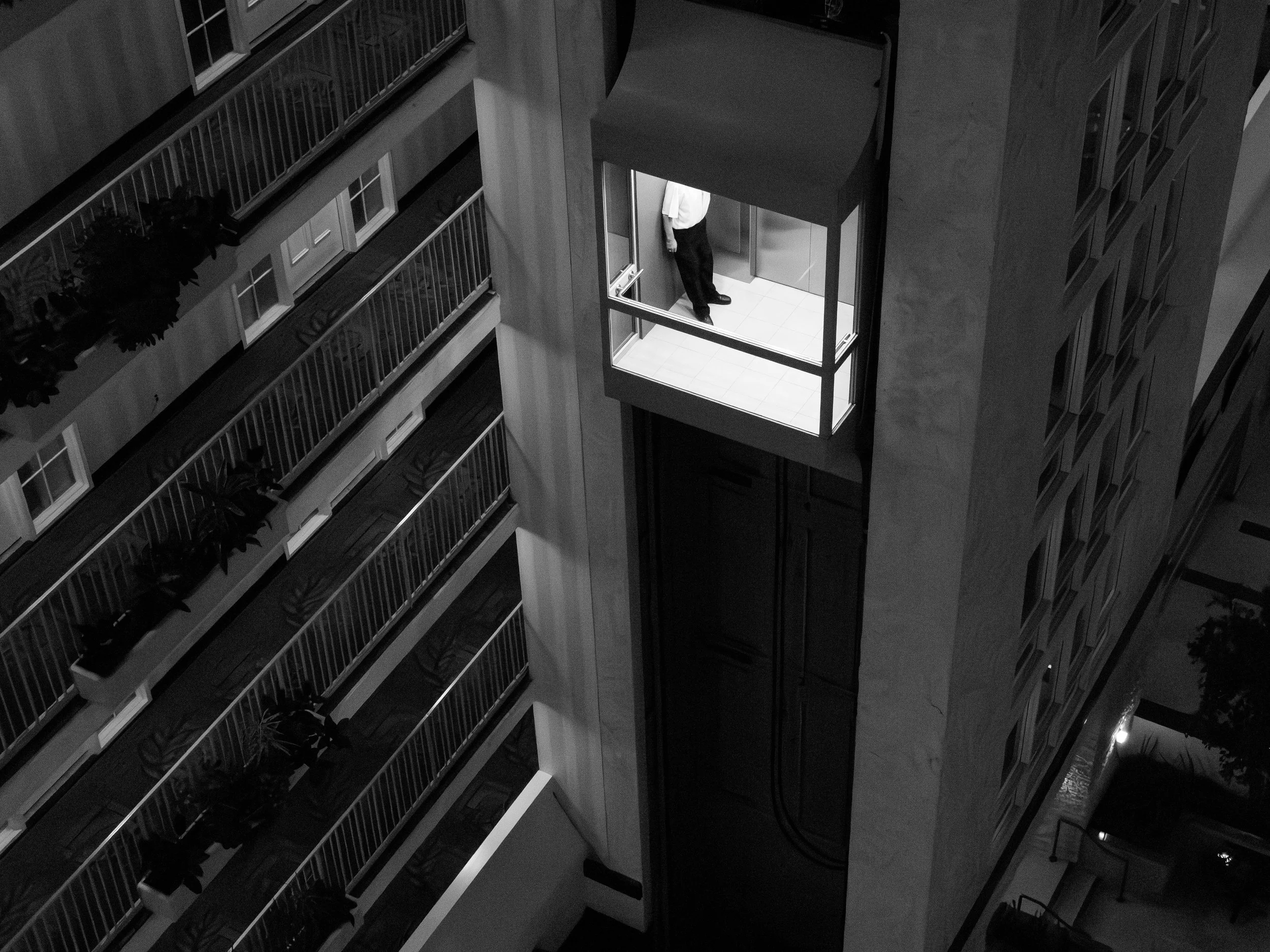
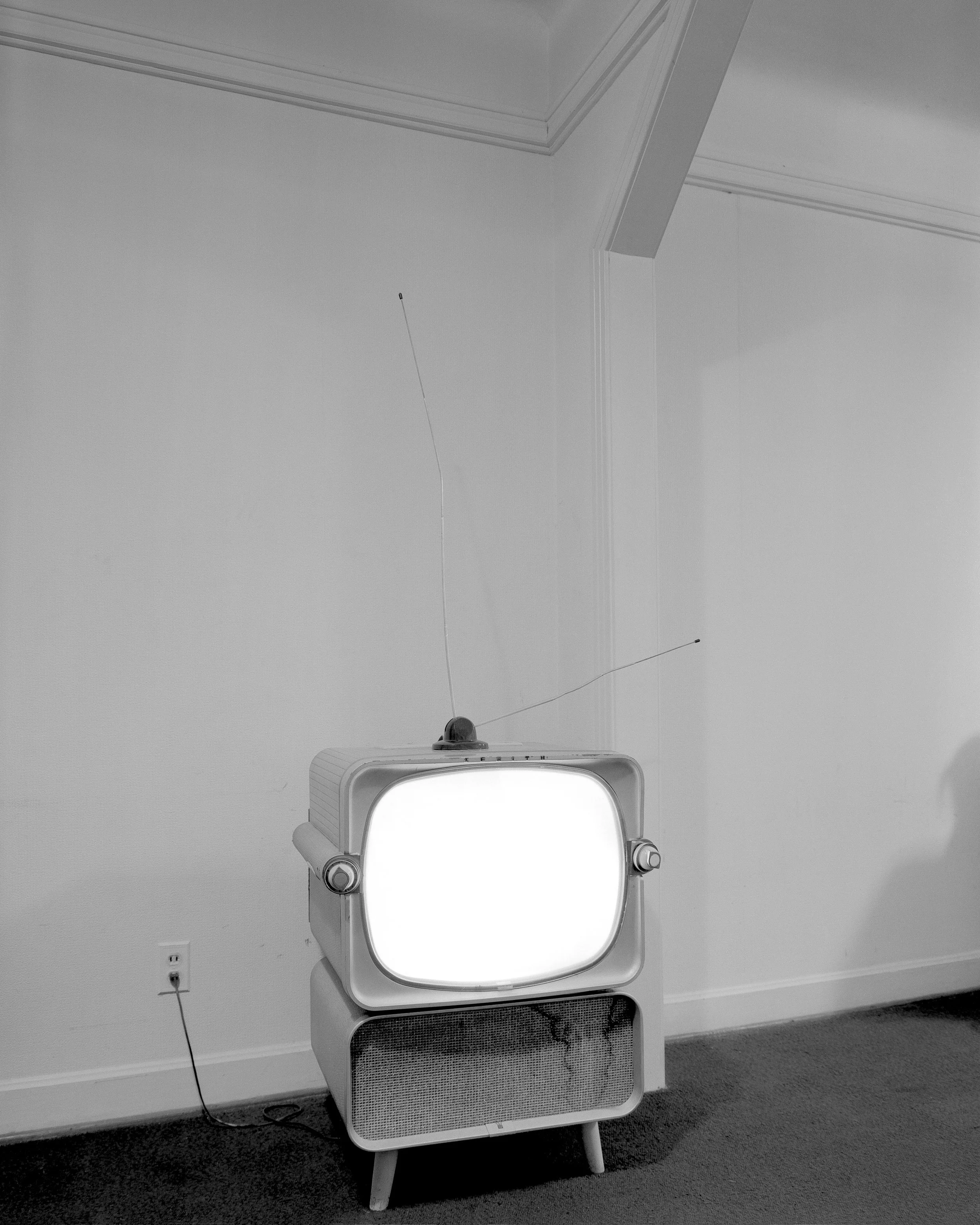
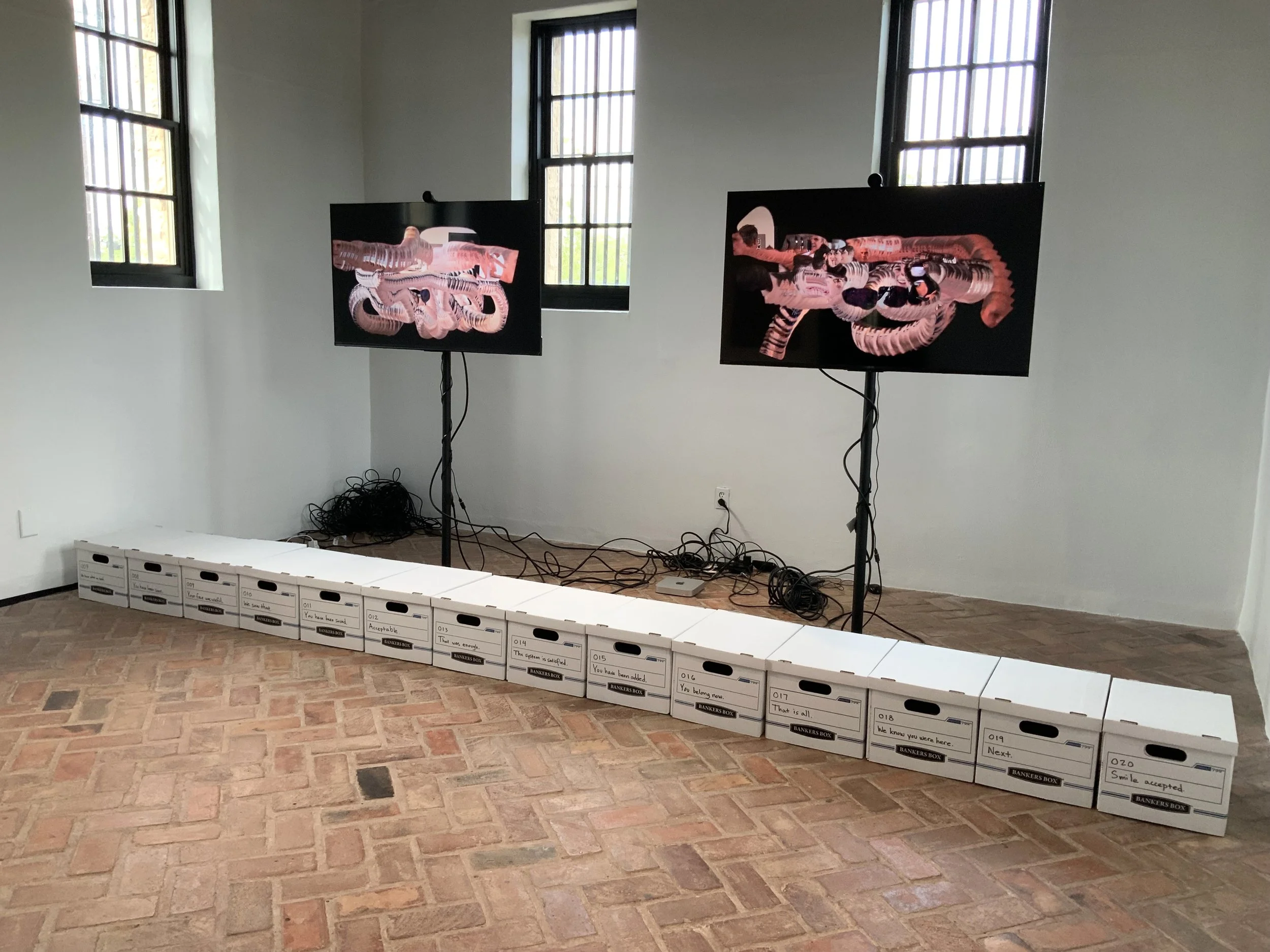
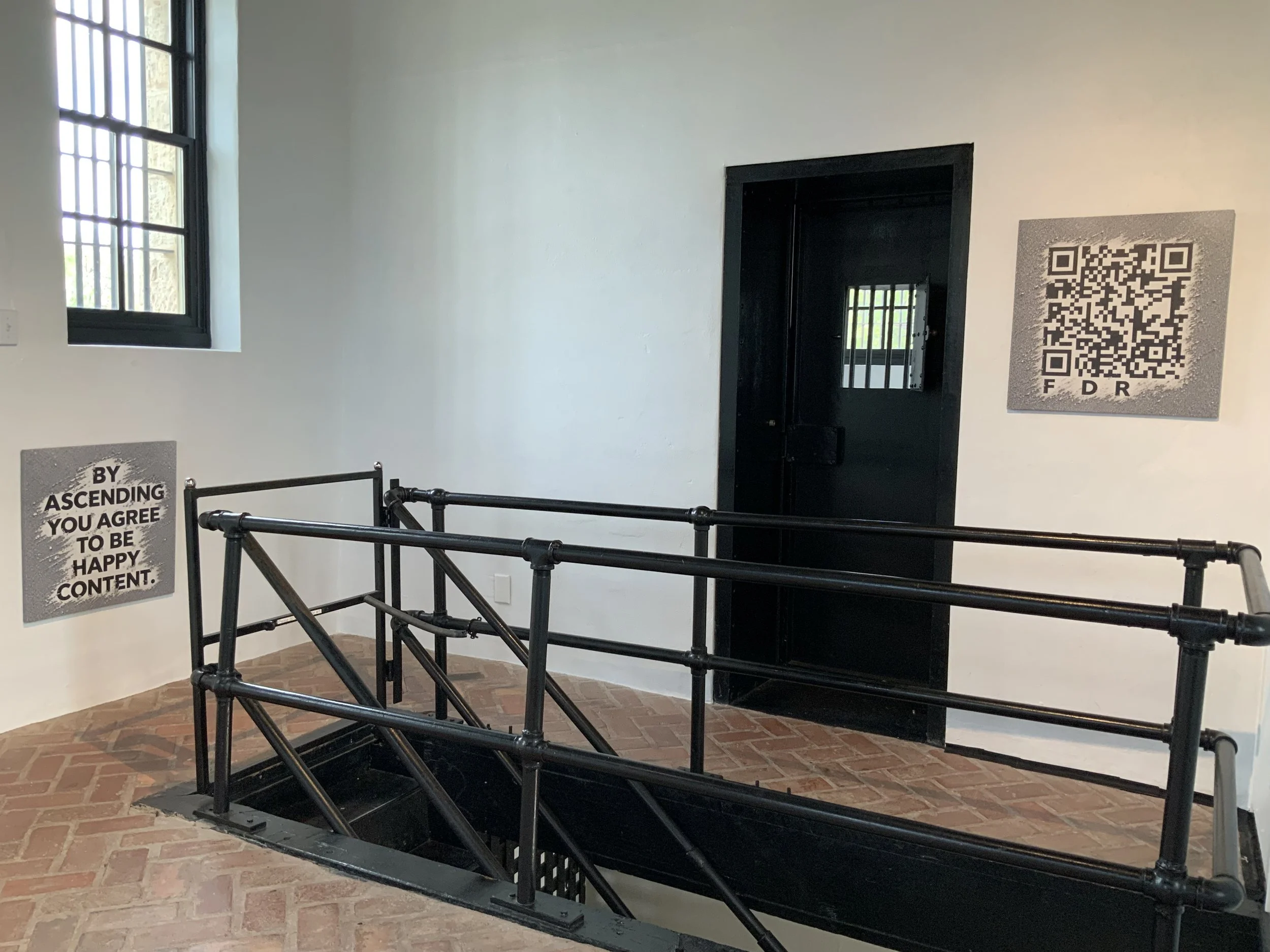
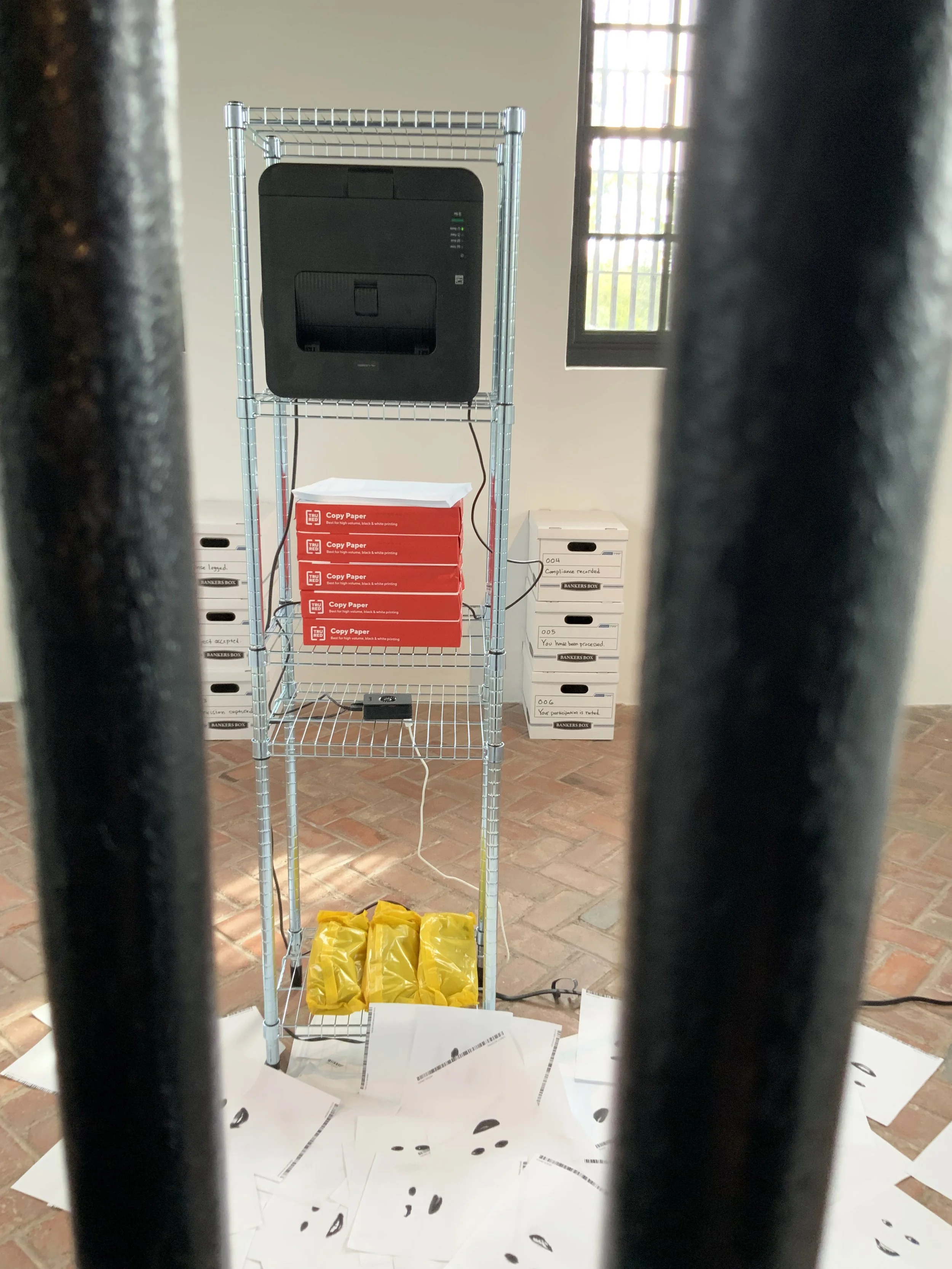
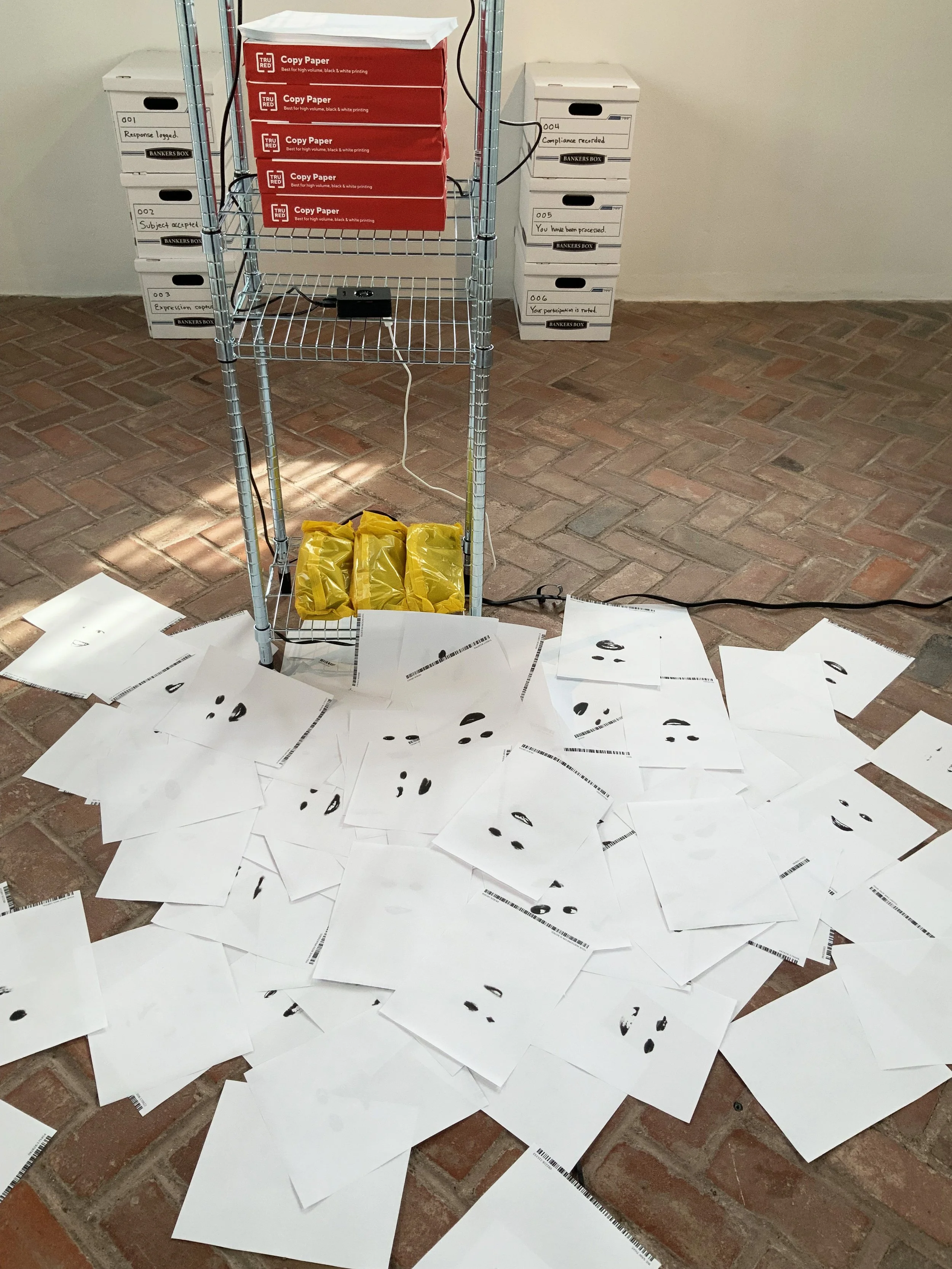
MF: What first grabbed me about the cells was that you have two rooms to work with. That linkage and detachment really stuck in my head, and I knew I wanted two linked things happening in those rooms. The bigger cell could feel a little like a performance area, while the second cell, separated from the other by a door with a barred window, could hold something inaccessible, where something is removed from you and cut off. I liked the idea of peering through that window and seeing something captured that you can't quite access.
That started me considering our relationship with content and social media, which has become this weird hybrid of offering ourselves up and performing for other people and for the platforms themselves. We know by now that we're not just creating content for these systems—we are also content for different unseen audiences within them. The whole “if it's free, you're the product” thing has become almost cliché. We understand the unequal deal we've made with most of our online services, but I don't think we really feel it. We keep feeding these systems, and they keep feeding versions of ourselves back.
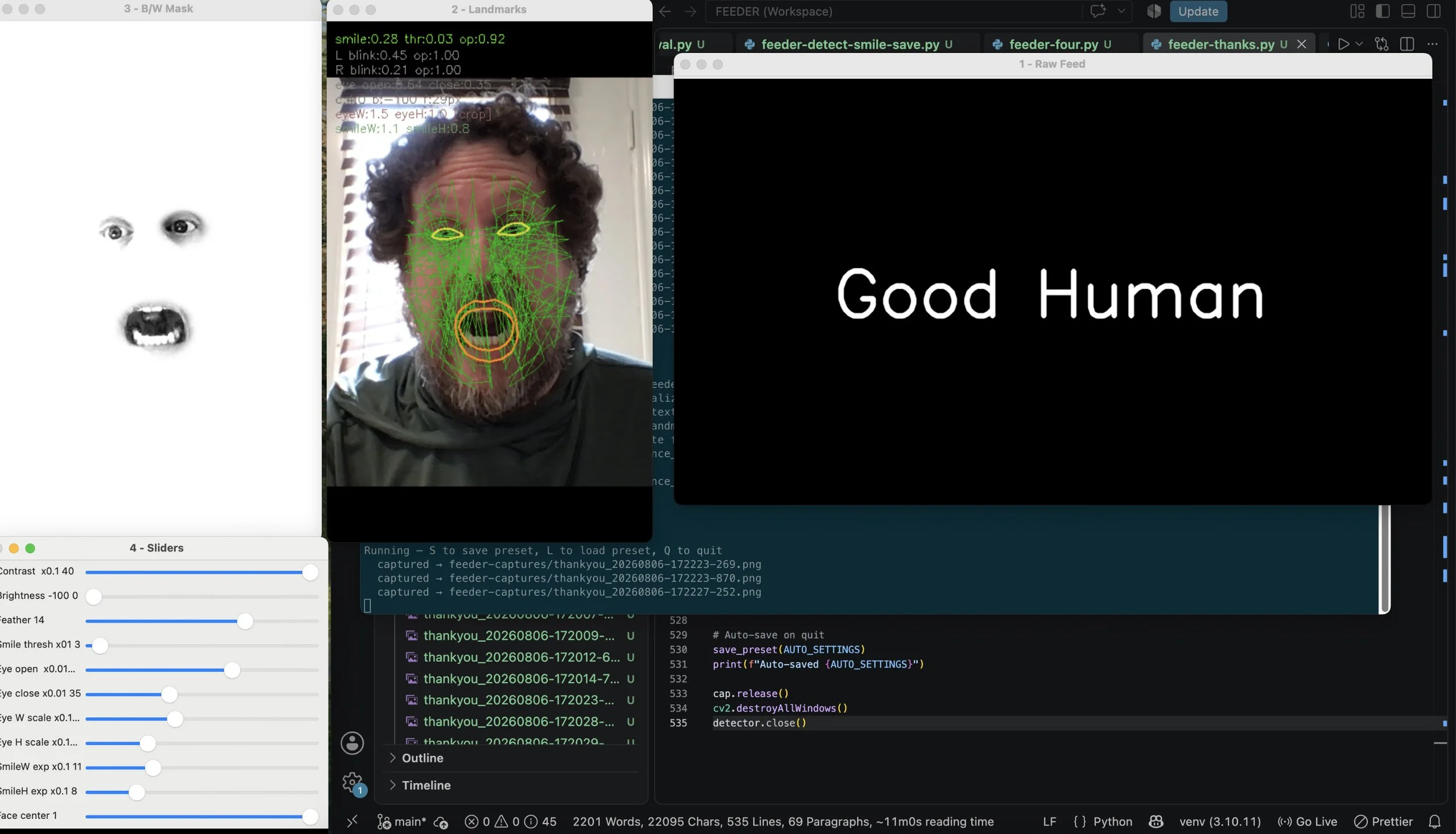
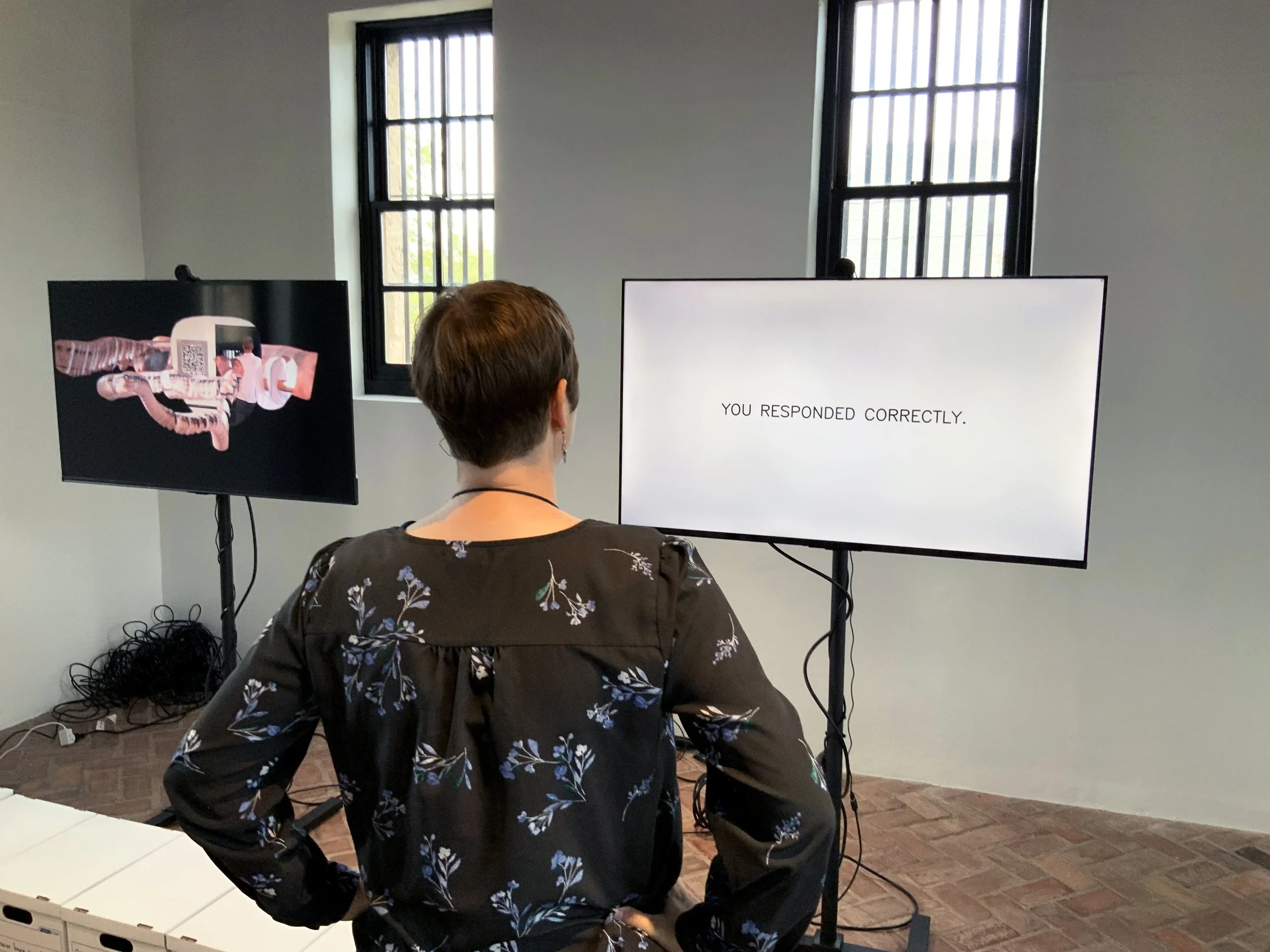
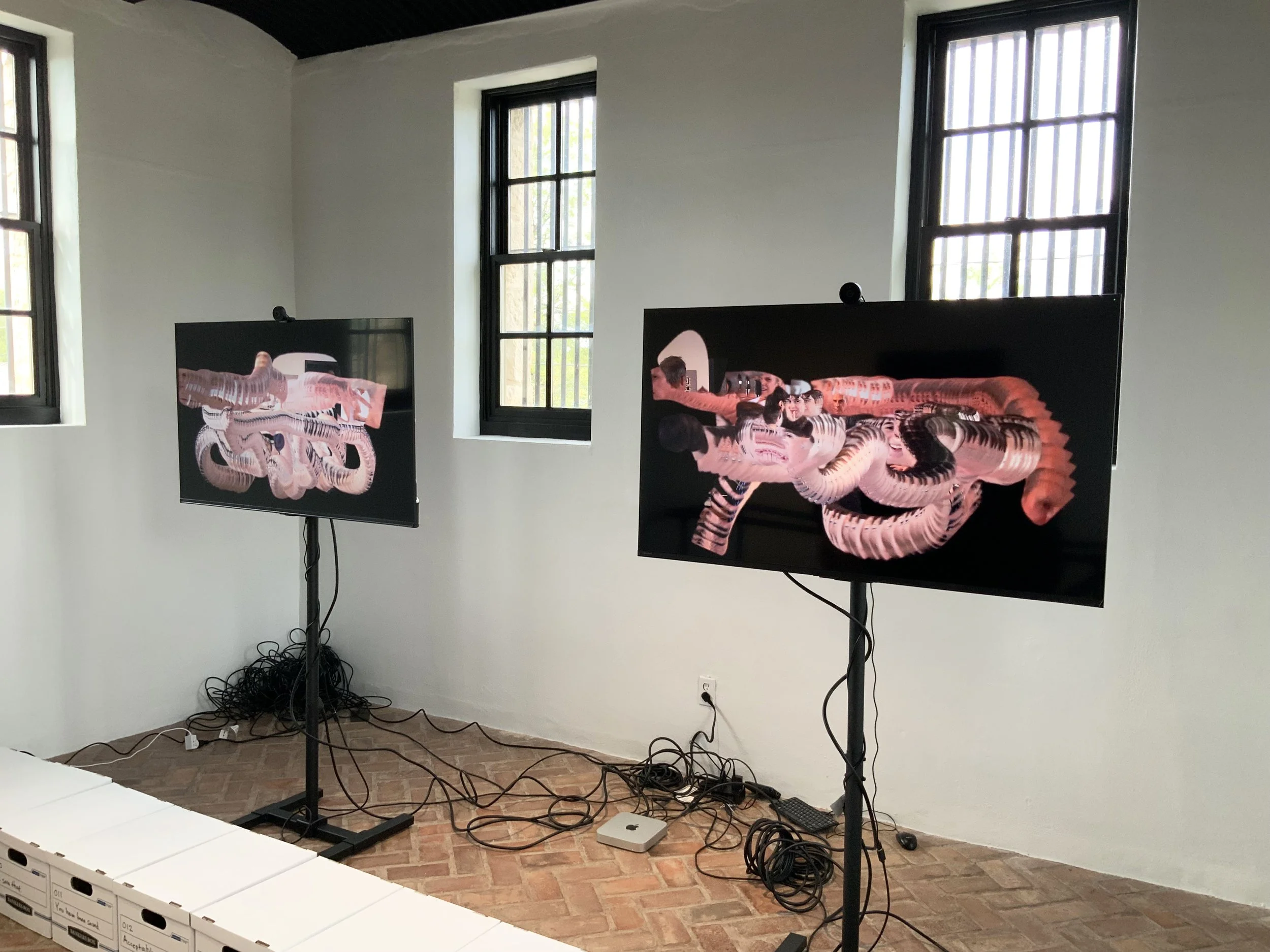
In the installation, the main room is where you interact with two screens that show your face and capture your image every time you smile. I knew I wanted the capture to be triggered by something, and joy or vanity seemed like a good enough trigger. What's been funny to me is playing with what gets categorized as a smile, because it varies from person to person. The system doesn't really care why you're smiling or even whether you think you're smiling. It just decides that you are.
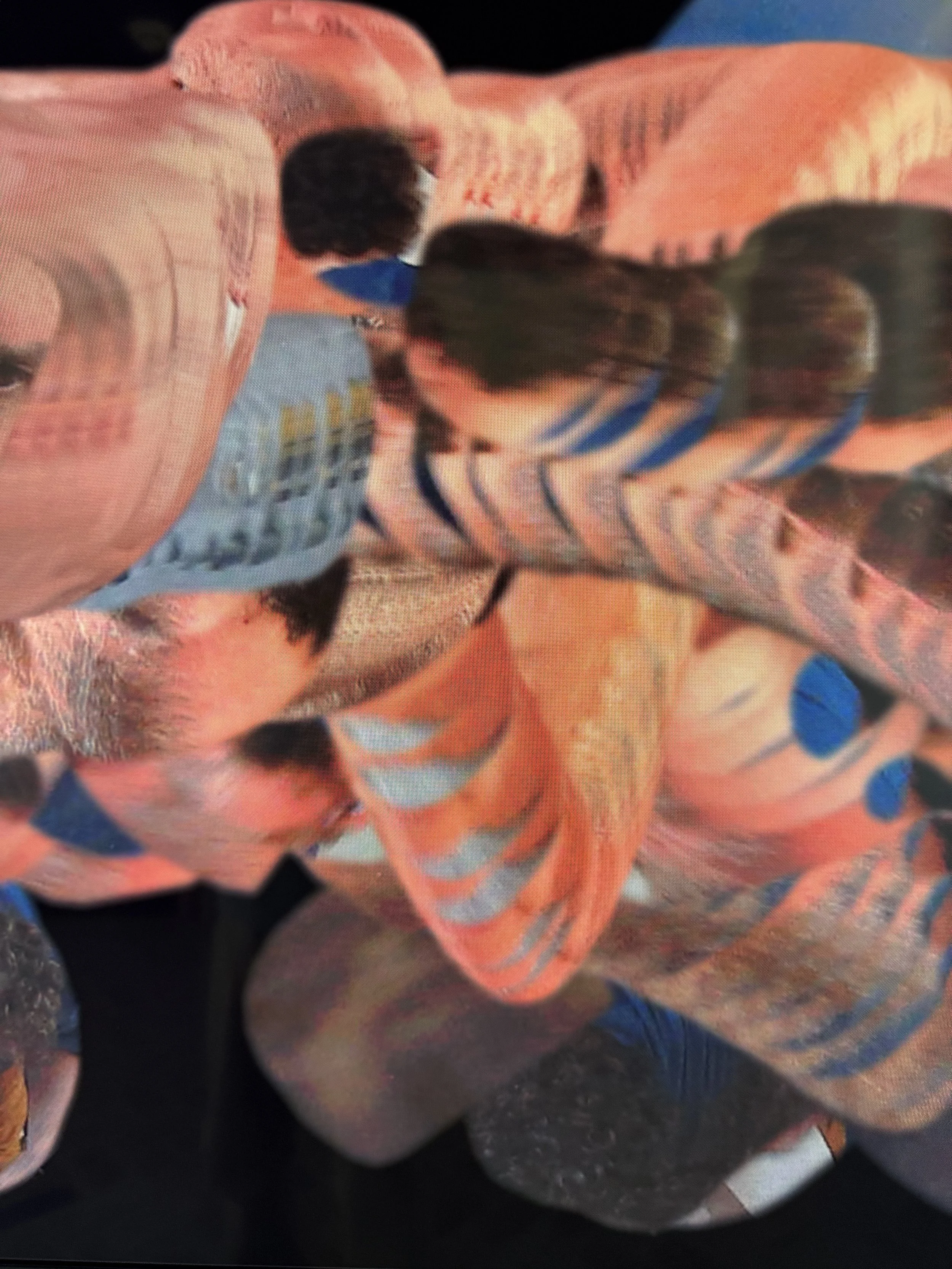
When someone smiles, and the system recognizes it, a thank-you phrase flashes on the screen, and it captures and creates an image. But it isn't really a portrait. It captures just the person's eyes and mouth, reducing them to functional bits. The system or platform wants your eyes to monetize, to keep feeding it your voice through clicks, likes, and other signals of attention. That image is then added to a queue and printed out inside the other cell. It's captured, altered, sequestered, and made inaccessible. Meanwhile, to complicate that clean separation, I've created an Instagram-like feed that logs each captured image. The audience can scroll through them, like them, and share them. So, the system takes something from you, stores part of it somewhere you can't access, and then gives another version of it back to you as something familiar and pleasurable to interact with.
I wanted to reduce the social feed to something minimal so we could concentrate on how we feed the system and how we are fed back to ourselves through platforms like TikTok, Instagram, even product reviews on Google. The people interacting with it end up being performer, producer, product, and audience at the same time. Hence the name “Feeder.”
I also enjoy reducing my titles by cutting out the vowels. It's another little puzzle for the audience, but it's also a nod to compression and to variable-naming debates in coding. I like how it tends to turn a title into a weird pun or create some other meaning that wasn't necessarily there before. Feeder becomes FDR, which obviously comes with its own political baggage. That wasn't where the title started, but I don't mind it. I actually like when the process introduces meanings or associations that I didn't completely intend. It makes the title another little system that produces something I didn't entirely control.