
IN THE OJAC CELLS SERIES OF EXHIBITIONS
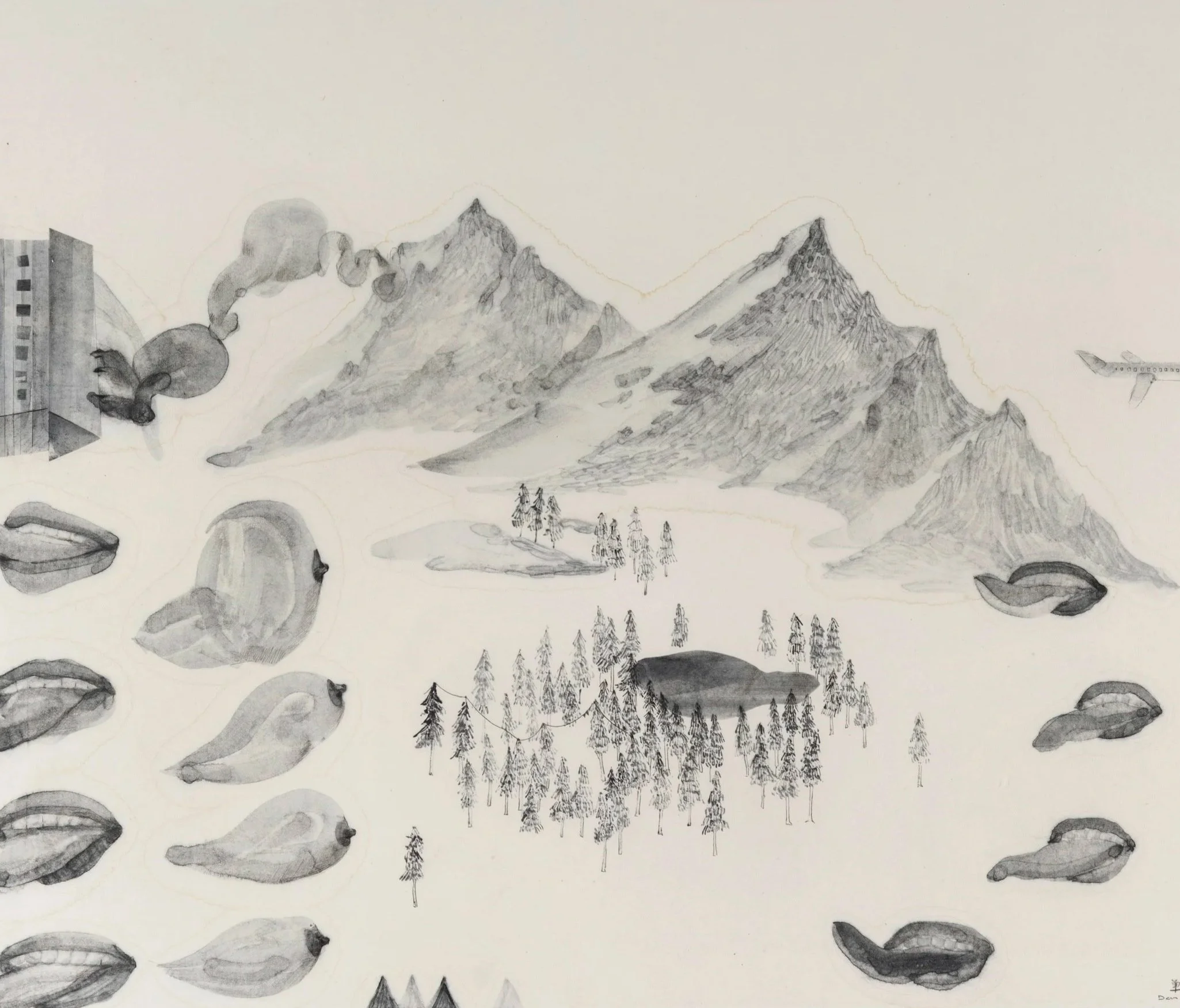
Dan Jian deftly employs painting, drawing, and animation in her work. In 2021, she moved away from figurative-abstract painting to focus exclusively on the medium of collage where every component of the image becomes part of a meditative, very detailed process. Inspired by the format of personal scroll paintings, where the movement of time is compressed without the feeling of an end, Jian’s works highlight ephemeralness.
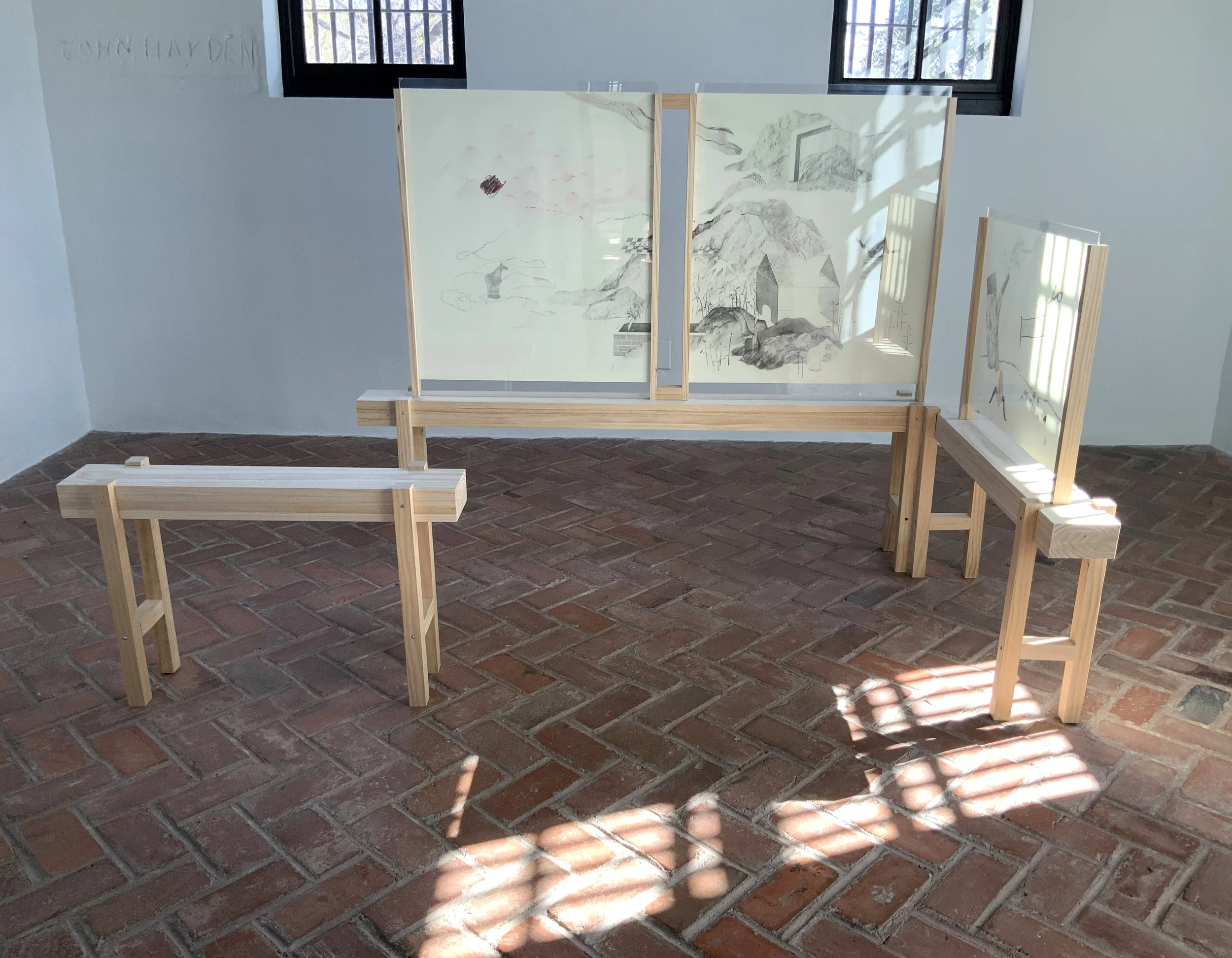
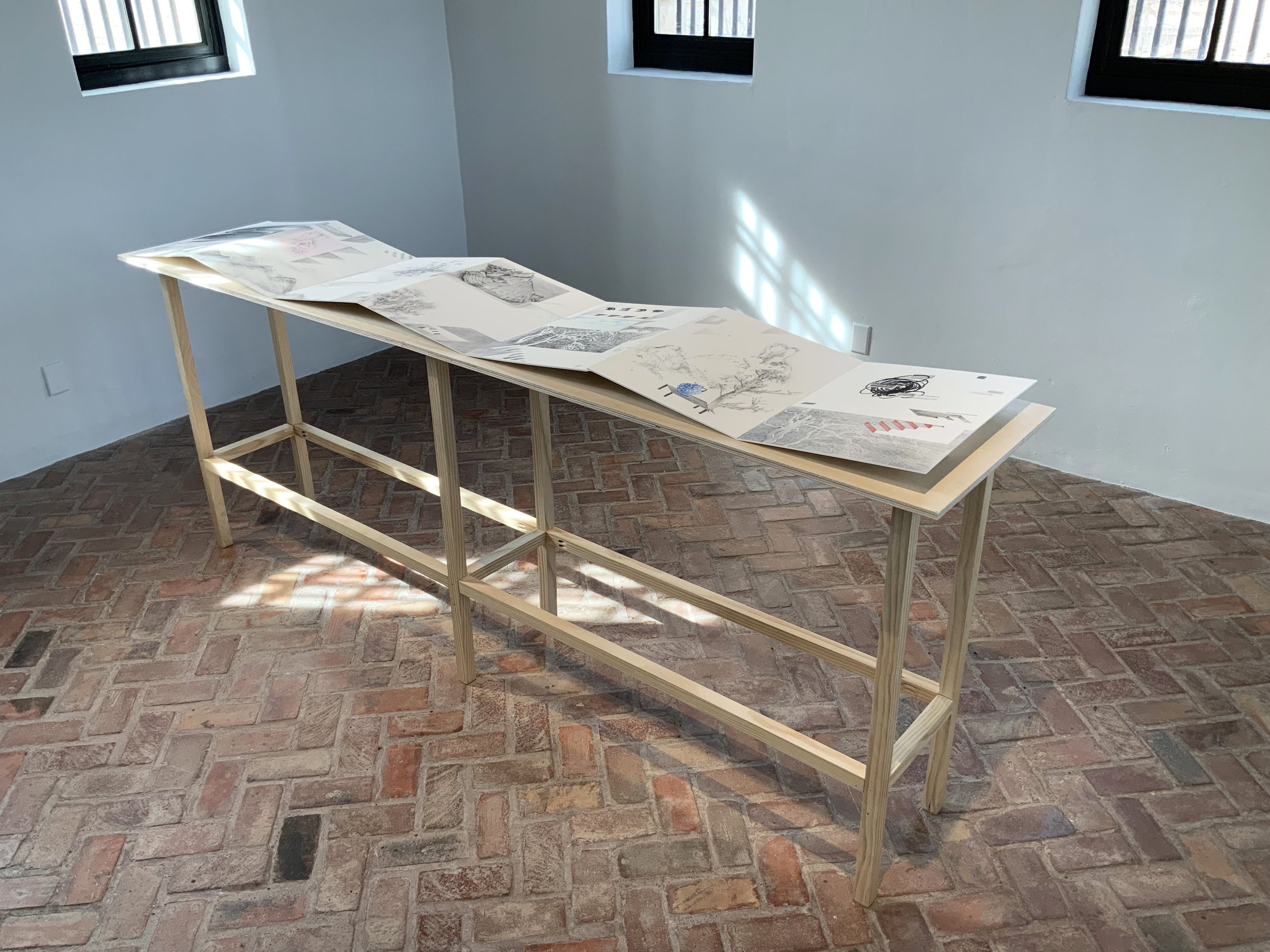
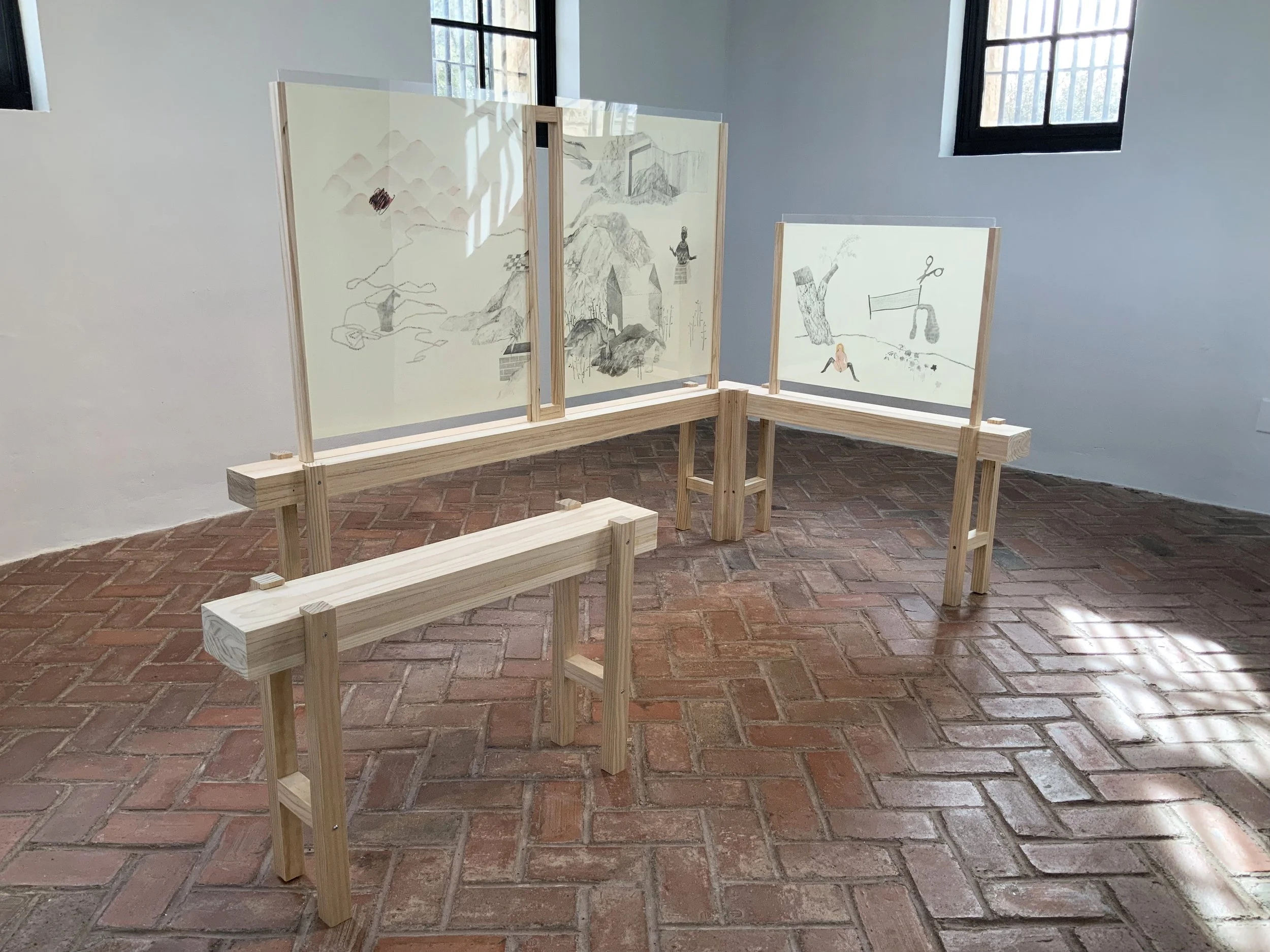
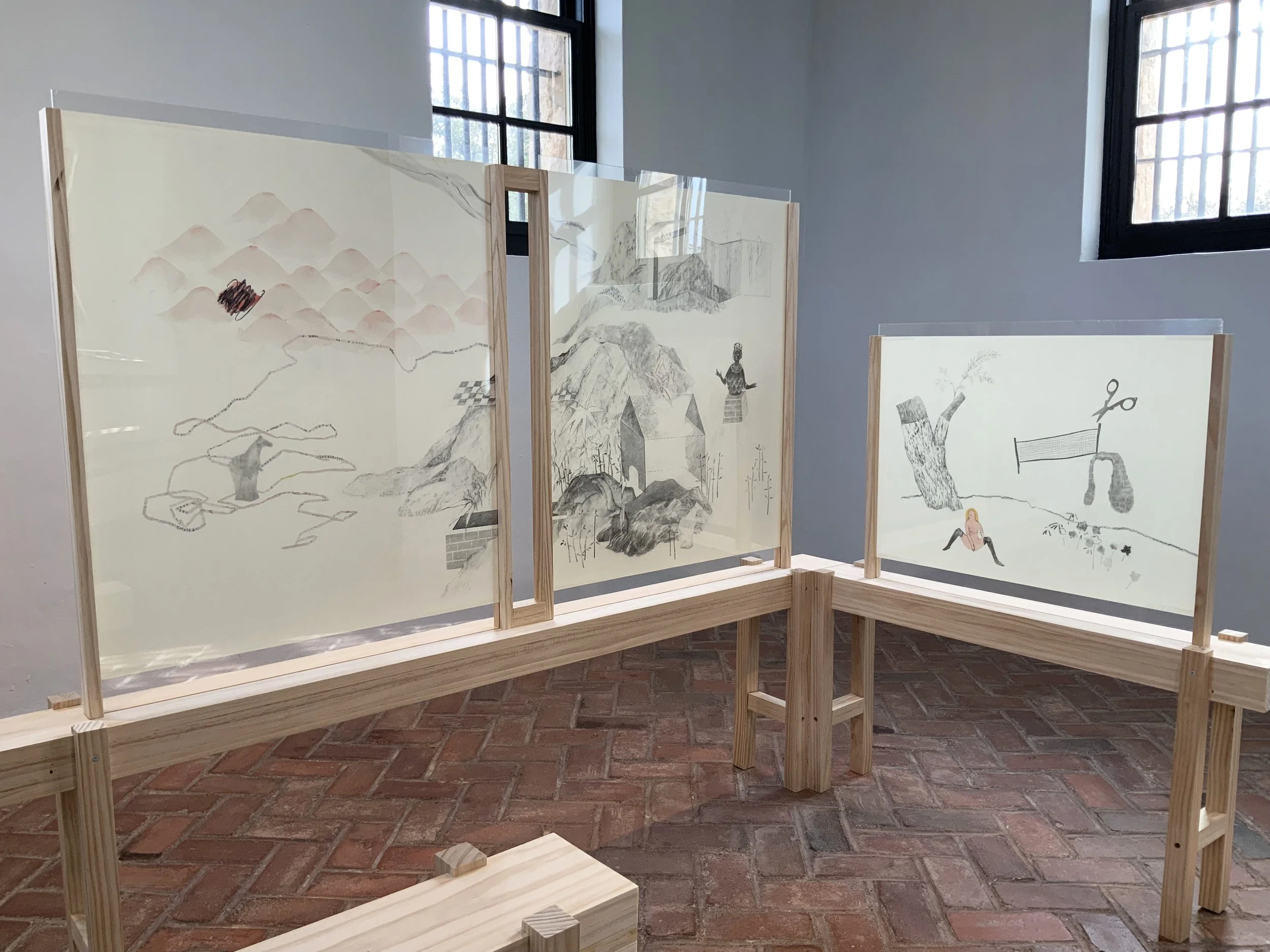
Jian’s Cell Series installation includes elements of collage and various drawing techniques to depict seemingly unrelated images. At times the individual images engage with one another or float independently in a sea of translucence. Shunning the conventional means of presenting works on paper, the artist constructs presentation devices that engage the unique spaces and constantly transform the works as the light of the day shifts with time.
Originally from the mountain region of Hubei, China, Dan Jian came to the United States at the age of nineteen. She received her BFA from Tyler School of Art and Architecture at Temple University and an MFA from The Ohio State University in 2016. Jian is an assistant professor of Art at Texas Christian University while maintaining an ongoing studio practice in Fort Worth, Texas.
Generously sponsored by The Andy Warhol Foundation for the Visual Arts and the Helen Frankenthaler Foundation, McGinnis Family Fund of Communities Foundation of Texas, and Kathy Webster in memory of Charles H. Webster, with additional support from Jay & Barbra Clack, Joe & Susie Clack, Jenny & Rob Dupree, and Dr. Larry Wolz

Patrick Kelly, OJAC Director and Curator, interview with artist Dan Jian (January 2026)
PK: Your media of choice is primarily drawing...in all its various means. What is it about that form of image-making that appeals to you?
DJ: Drawing appeals to me because it functions as a method of seeing and discovery. Art critic and novelist John Berger said, “Drawing is Discovery,” and I can’t say it better, so credit to him. I think what is understood here is that there is an inherent “open-endedness” in this form—I can start by making a mark (sometimes a collage) on a blank page with absolutely no preconceived idea of the outcome.
This is a low-stakes, accumulative process that feels mundane to me. What I mean is that there is always a sense of trying to be “eventful” in painting, but drawing feels ordinary, and that is very appealing to me. I know I can start work in the studio any time because all I need to do is sit at my table, then one mark will follow another. Those are small decisions that allow me to move through a subject, rather than choreograph any arrival moment.
I didn’t always see drawing this way. As an art student in China, when I was younger, I trained in drawing, building skills that convincingly captured three-dimensional form. I remember once trying hard to render a light switch plate so precisely that someone might want to flip it. Back then, the appeal was to impress others. Now, drawing is still about perception, but in a self-exploratory way—it's a game of interweaving the act of drawing with image-making, while retaining that sense of searching and discovery.
PK: I would assume that the non-objective marks are intuitive or reactive. Are the recognizable images you create intuitive as well, or do you utilize a library of reference material—or is it a combination of both?
DJ: It’s a combination of both. I do have a personal library of collected images, and it’s growing. These are clips or cut-outs from printed media. When I select a recognizable image and place it on the page, it triggers a direction for narrative interpretation. I expand the rest of the page in response to that, sometimes with abstract marks, sometimes with other recognizable images. This process can also work in reverse—I start with gestural marks and then add recognizable images afterward.
PK: What’s the criteria for an image to be added to your “library”?
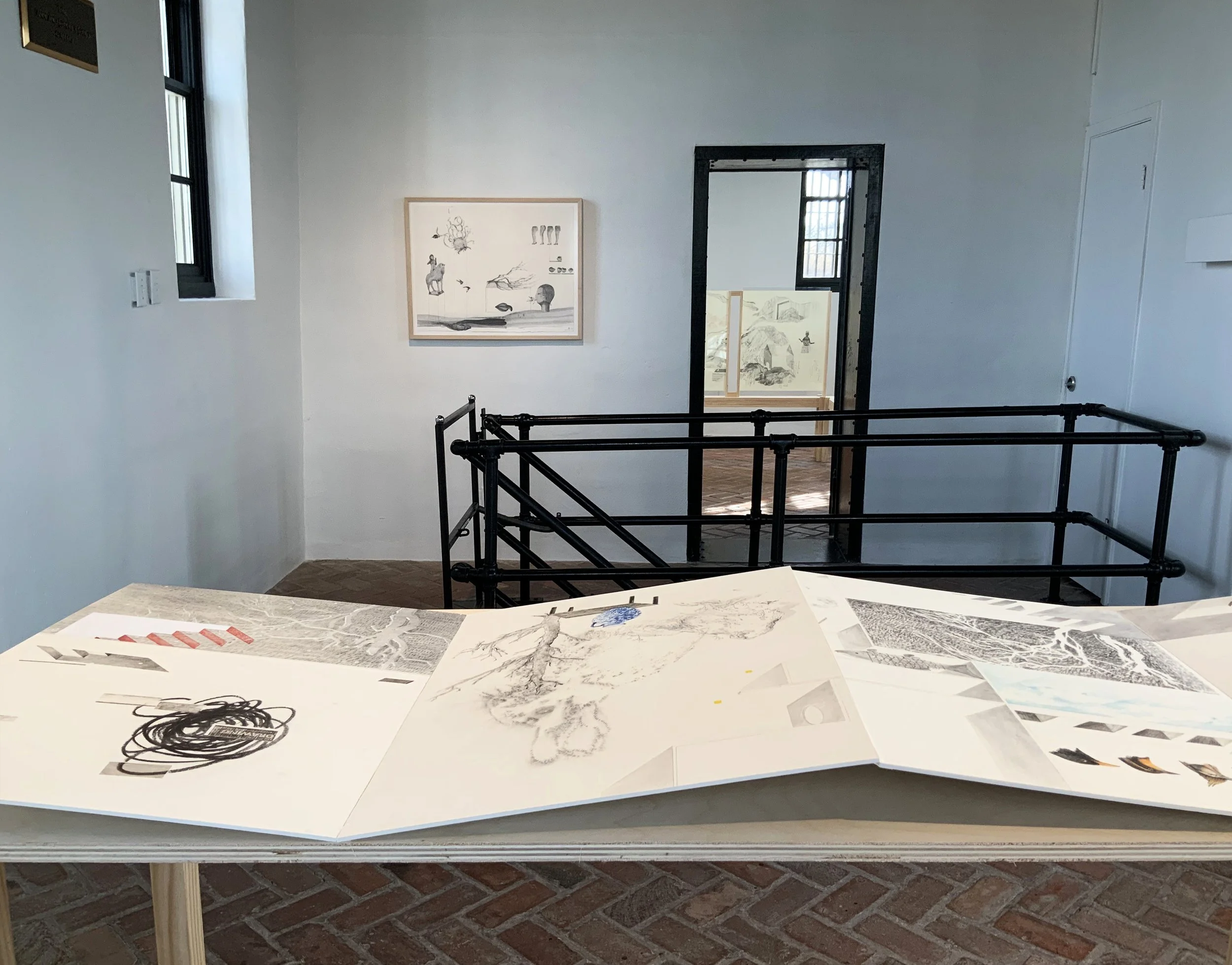
DJ: Any image that sparks curiosity or resonates. It's either something visually interesting like color, texture, strange composition, or its cultural context. They tend to be about nature, landscapes, domestic objects, or historical records/artifacts. When I draw the human body, I tend to do only parts, legs, breasts, mouth, and tongue, etc. They have their own agency without needing a head or brain. When I first visited OJAC, those Chinese tomb figures on display were like magnets for my eyes. Recently, one of the tomb figures was recreated in a drawing called Library of Partial Things, along with another image reference from Diderot's Encyclopedia, and a crab. They are ordinary images, but together they can seem ridiculous.
PK: I’m aware that you utilize different “drawing” techniques, from traditional pouncing to utilizing washes of liquid graphite, all within one work. Why do you use one technique over another to render an image?
DJ: I juxtapose different “drawing” techniques to specifically point to the plural and ubiquitous nature of drawing processes. In this sense, it is more about presenting a wide range of techniques rather than choosing any one. During my process, I choose based on the nearby or previously used drawing method and visual quality, balancing it with a sense of narrative flow and reminiscence of imagination.
Pouncing, as you mentioned, is an old transfer technique, historically used to transfer a preparatory drawing onto canvas or wall surface in preparation for painting or fresco. I isolate and feature this process in my drawing to appreciate it as it is, one with a unique visual and poetic quality—each pinhole creates a tiny explosion!
PK: You did a site visit to see the cell galleries more than a year ago. Can you briefly describe the iterations of installation possibilities that transpired over that time, knowing that a lot of work happens in an artist’s head prior to even beginning the physical aspect of physically creating work?
DJ: During my initial visit, I was interested in the complex, layered history of the space and its location: the original function as a jail, the architecture, the history of art collection, etc. But, I was also struck by detail moments of the site, such as the “John Hayden” carving in the east cell, the stonemasons’ initials, and that old, twisted tree at the front of the building (gorgeous). I thought this would be a really good challenge for me, as I had never worked with a space this densely charged. I remember writing “When the Silence is So Loud” to summarize my impression of the cell rooms, and I thought my work would be a direct response to the site's history.
My early thinking leaned toward direct reference and research. I collected old documentation of John Hayden, read about the history of the Texas frontier, and made drawings to include visual references from the museum’s permanent collection. I attempted to make a conceptual connection between OJAC and Italo Calvino’s book, The Invisible City, and reflected on whether my immigrant background could inform a narrative about the space. In all of these readings and free association, I was waiting for an “Aha!” moment, but nothing convinced me.
As time passed, I started to question whether making work about the history was the most attuned way to engage. In the Fall, I abandoned historical research and just started drawing with no direction or agenda. I trust that my early experience during the site visit and all the reading conditioned me to make intuitive connections. I know I am still responding to the site, just indirectly.
Now that the work is mostly done, I see retrospectively that those drawings, from the image narrative to the format, are all about what is imaginable while in restraint. In hindsight, the cell room has served as a metaphor for the drawing marks and the paper, or the freedom that can exist within an enclosure.
PK: That is a great answer and we could stop there, but one more question. The average viewer anticipates drawings to be conventionally presented—in frames and on the wall. Why did you elect to treat them as objects?
DJ: I had originally considered framed drawings and wall hangings, but I ultimately felt that the architecture and the psychological space of the cell spaces were too dominant for that. These rooms were designed with a very specific purpose: to contain a free body in captivity, and all the elements—the scale, layout, and material—assert that intention. There is bodily awareness when one is in the space. The placement, materials, and format of my drawings are adapted to engage more directly with what is felt in space.
I placed the drawings at the center of the room to prevent the architecture from subordinating the two-dimensional work. I chose to use vellum and position the work in front of the east cell windows to engage the light coming through. Specifically, I imagined the morning sun glowing through the translucent paper like a lantern. Additionally, because my drawings tend to work as a series, I built “benches” so they could sit together as a group. The accordion-book format in the opposite cell reflects a sense of non-linearity and continuous unfolding, or memory as a movement.